Thabisile Gumede
7 September 2026
When Marthie Hauptfleisch sat down to analyse the responses of hundreds of Grade 11 and 12 learners for her Master of Nursing Science research, one number stopped her cold. Almost every young person in her study understood the basics of sexual health. Yet only 27% reported using contraception. The facts were there. The behaviour didn’t follow.
“Information alone is not enough,” Hauptfleisch says. “Young people also need the practical opportunity and support to act on what they know.”
That gap between knowing and doing became the heart of her research, and it’s the reason she now has a phrase she repeats often, one simple enough to fit on a T-shirt but weighty enough to reframe how we think about adolescent decision-making: “The biggest condom is a dream.”
It sounds like a slogan. It’s actually a finding. When she asked adolescents what shaped their choices, future goals came out on top, cited by 62% of respondents, followed by health at 55%. Personal choice was the leading reason young people gave for choosing abstinence. Her interpretation is straightforward: a teenager who can picture a future worth protecting starts protecting it now, in the present, in the decisions they make today. It’s not that hope was measured as its own variable in the study, she’s careful to clarify, but future goals clearly were, and the pattern was unmistakable.
To understand why knowledge and behaviour split apart so often, Hauptfleisch turned to Bronfenbrenner’s ecological model, a framework that refuses to look at a teenager in isolation. It maps outward in rings: the individual and their own values and self-regulation, then the microsystem of family and friends, then the mesosystem where schools, clinics and communities either connect or don’t. Her research found that Life Orientation teachers were the dominant source of sexual-health information for these learners, but the coordination between schools and clinics was often weak, which limited how much of that classroom knowledge could actually translate into services and support.
Further out sit the exosystem and macrosystem, the forces most people never think to blame or credit for a teenager’s choices, things like a parent’s work pressures, government policy, culture, religion and household income. The numbers here are sobering: 38% of learners in the study reported no working adult in their household, and among those who disclosed income, 41% lived on less than R5,000 a month. Culture and religion cut both ways, sometimes encouraging abstinence, sometimes making it harder to talk openly about contraception. But policy can also open doors. Hauptfleisch points to South Africa’s return-to-school policy as a genuine lifeline, allowing adolescent mothers to continue their education rather than being pushed out of the system entirely.
She’s equally careful about what her research doesn’t claim. Mental health featured heavily in the discussion around her findings. Still, she’s quick to draw a line: her study did not diagnose mental health conditions or prove a causal link between mental health and sexual behaviour. What it did show is that peer pressure is real and specific, with friends identified as the most common source of pressure to become sexually active, cited by 36% of respondents. The takeaway isn’t a single cause. It’s a call to see young people holistically, shaped by layers stacked one on top of another.
Hauptfleisch, a nurse, researcher and songwriter, wasn’t willing to let this data sit in an academic paper. That’s the thinking behind Hey Brain, a campaign that uses music and creativity to carry the research into everyday conversation, and Stellcare, which is turning that work into community action, with a public launch set for 17 September 2026. Her message to parents, teachers, nurses and community organisations is simple: this isn’t one sector’s job. It takes all of them, working in the same direction, to give young people something worth protecting.
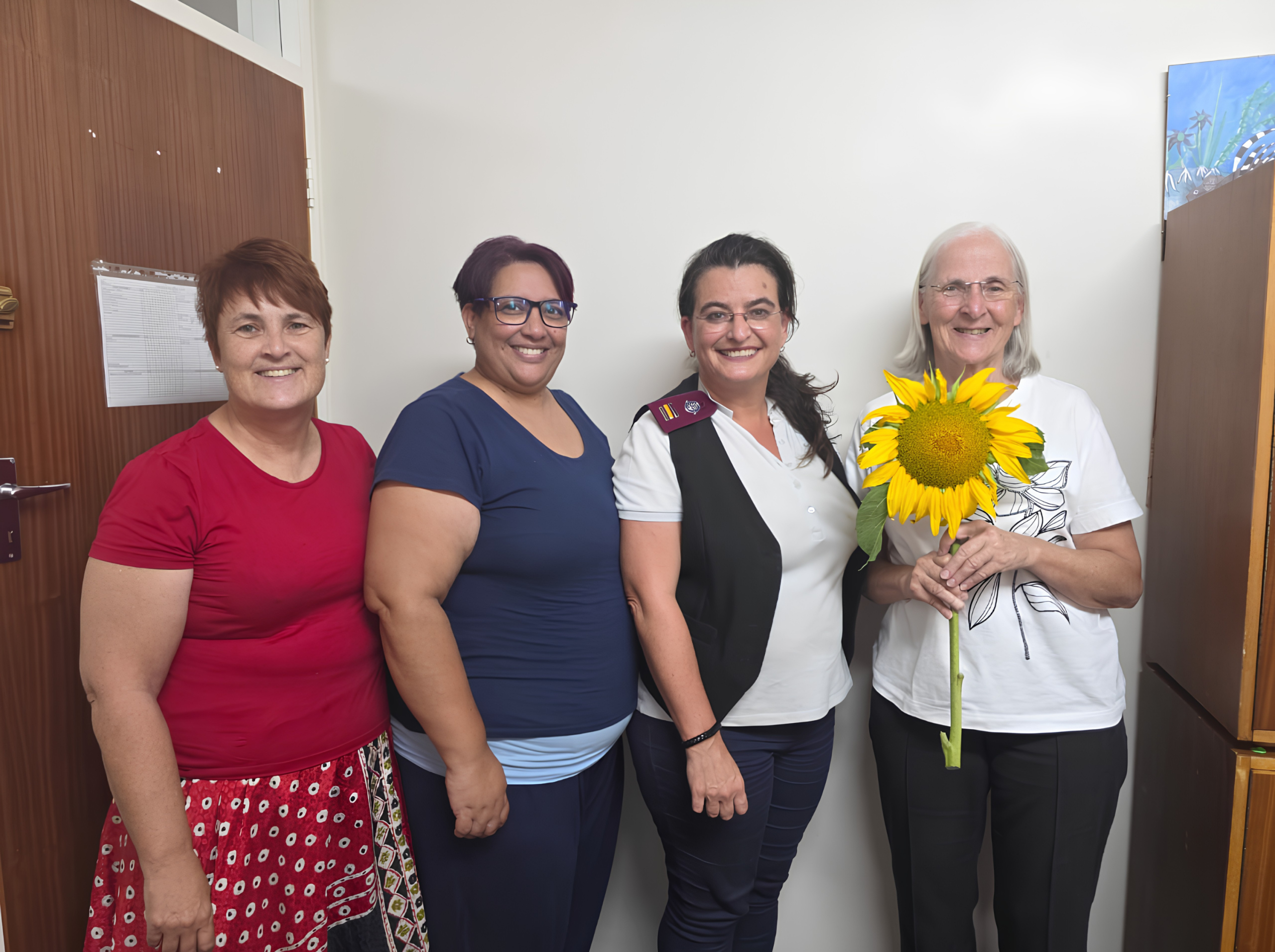
In the picture: L-R: Heidi de Jager, Mabré Wenn, Marthie Hauptfleisch & Bettie Niewoudt- Stellcare
For more information: www.marthienel.com