Buhle Gigaba
25 November 2026
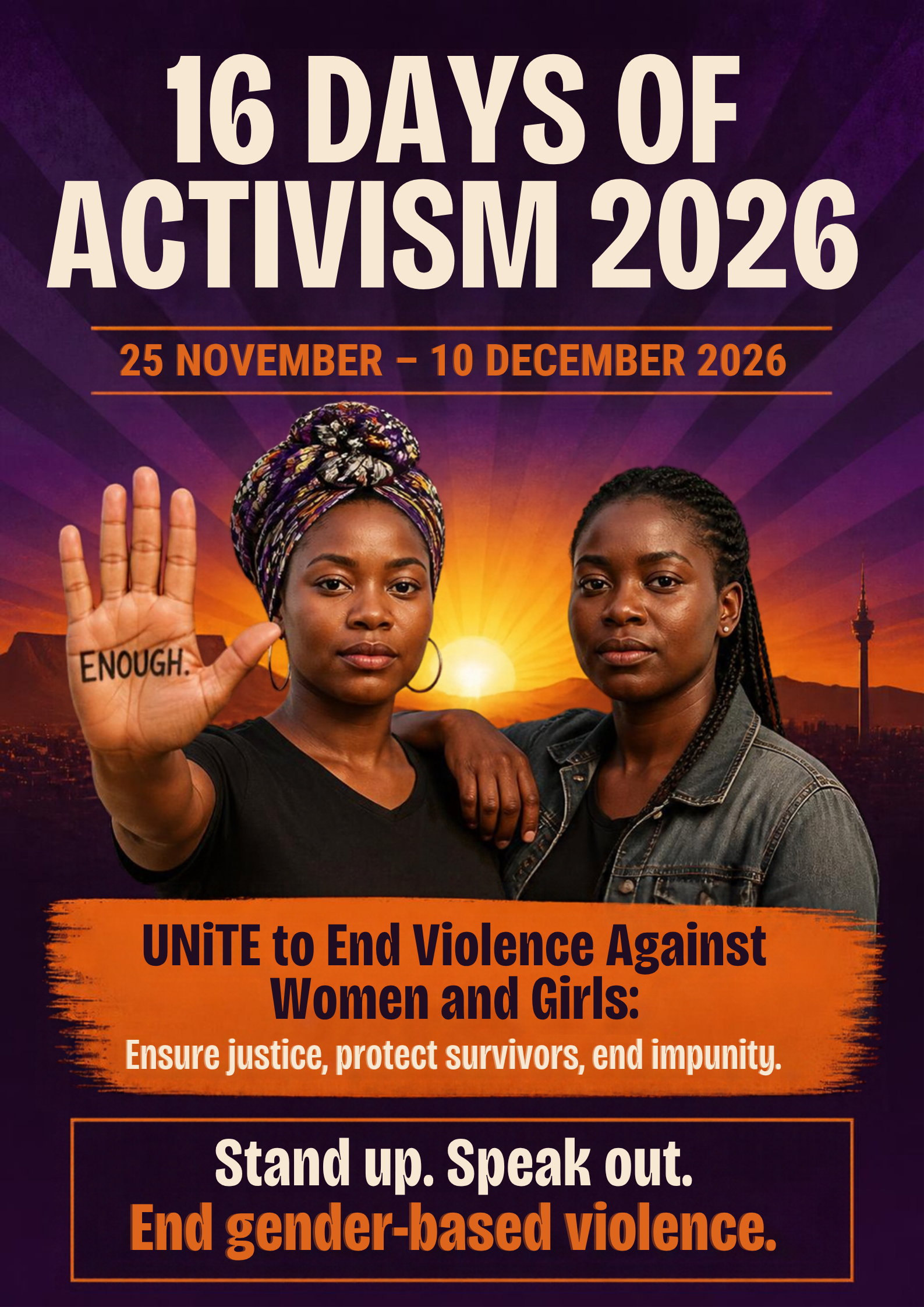
Each year, from 25 November to 10 December, South Africa joins the global 16 Days of Activism for No Violence Against Women and Children, a campaign running from the International Day for the Elimination of Violence Against Women to International Human Rights Day. It is one of the most visible awareness campaigns on the national calendar. What receives far less visibility is what happens after the 16 days end, when survivors are left to live with the psychological aftermath of violence long after the marches, hashtags and government statements have faded from view.
The scale of the crisis behind the campaign is difficult to overstate. The first South African national gender-based violence study, conducted by the Human Sciences Research Council and released in 2024, found that an estimated 7.3 million women in South Africa have experienced physical violence at some point in their lives, with 2.1 million, or 9.8 percent, reporting a lifetime exposure to sexual violence. The following year, President Cyril Ramaphosa formally declared gender-based violence and femicide a National Disaster, a designation reflecting the scale and persistence of the crisis rather than any single incident.
What these statistics represent, beyond the immediate physical harm, is a population of survivors carrying significant psychological injury, often without adequate support to process it. Trauma responses to gender-based violence commonly include post-traumatic stress, depression, anxiety and a lasting erosion of trust and safety that can affect every part of a survivor’s life, from relationships to employment to parenting. For many survivors in South Africa, this trauma unfolds against a backdrop of the same treatment gap explored elsewhere in this magazine, limited access to psychologists, long waiting periods at public health facilities, and mental health services that are simply absent in many communities.
The Psychological Society of South Africa has used its own platforms to push this dimension of the crisis further into view. In reflections shared ahead of recent 16 Days campaigns, the organisation’s leadership has spoken to the widespread psychological impact of gender-based violence, emphasising both the urgent need for systemic change and the essential role psychology has to play in advancing safety, healing and justice for survivors. That framing matters because it resists treating gender-based violence purely as a criminal justice issue, important as arrests and convictions are, and insists on healing as an equally necessary part of any real response.
Recent campaign themes have also begun to reflect a shift in emphasis, toward collective responsibility rather than a narrower focus on survivors and perpetrators alone. One recent 16 Days theme, Letsema, calls on men, women, boys and girls to work together to end gender-based violence and femicide, drawing on dialogue around positive masculinity as part of prevention. This connects directly to the themes explored in this issue’s other features on men’s mental health, since the same rigid ideas about masculinity that discourage men from seeking help for their own struggles are frequently implicated in patterns of violence and control.
For survivors, meaningful support looks like more than a 16-day window of national attention. It looks like trauma-informed counselling available in the same clinics where survivors report abuse, not routed through a separate, harder-to-reach referral system. It looks like community-based support structures, similar to the peer and lay counselling models explored elsewhere in this magazine, trained specifically to recognise and respond to trauma. And it looks like sustained funding for organisations doing this work year-round, not only during the campaign period when public attention is highest.
As South Africa marks another 16 Days of Activism this November and December, the invitation is to look past the campaign’s visibility and toward its aftermath. Ending gender-based violence is the ultimate goal, but for the millions of South Africans already carrying its psychological weight, healing cannot wait for that goal to be reached. It needs to be resourced now, consistently, and for as long as it takes.